
• Skip to primary navigation
  • Skip to main content
HeretoLead

HeretoLead

Boys and Men of Color are Here to Lead

  • Home
  • The Campaign
    • HeretoLeadCA
    • About California Funders for Boys and Men of Color
    • News
  • Stories
  • Get Involved
    • Nominate a Leader
    • Resources
    • Join Us
    • Share this Campaign

PrimaryAdmin

Devon Gray: Centering Community Perspectives

PrimaryAdmin · October 4, 2023 ·

Devon pictured at Jack London Square in Oakland

“Systems have been influenced by false narratives that poverty is a result of individual or moral failure and that people experiencing poverty are fundamentally flawed. EPIC is changing that narrative. It’s not the people. Poverty is driven by policy choices that have set people up to fail.”

Devon Gray

We had the opportunity to sit down with Devon Gray, President of End Poverty in California (EPIC), an organization that elevates the voices of people experiencing poverty by creating and implementing bold policies rooted in their needs. Learn more about Devon and EPIC’s work to build people power and center community perspectives below.

Devon Gray was born and raised in a town called Placentia in North Orange County, California. “Growing up in a place with such extreme inequality really shaped my perspective on poverty and economic mobility throughout California. People think about Disneyland and beaches and reality TV when they hear about Orange County, and that’s definitely part of the story, but it’s an incomplete story. Orange County has the second highest poverty rate of any region in the state, behind LA County,” says Devon. 

In Orange County, Devon grew up seeing lush, gated communities just blocks away from largely immigrant, low-income housing. He attended public schools with students primarily hovering around the poverty line.

“With the low-income kids that I went to school with, no matter their brilliance or their hard work or their ingenuity, the circumstances of the neighborhoods that they grew up in put a ceiling on their potential. For the kids who grew up really privileged, no matter how many mistakes they made or the trouble that they got into, they had a floor on how far they could fall down,” he says.
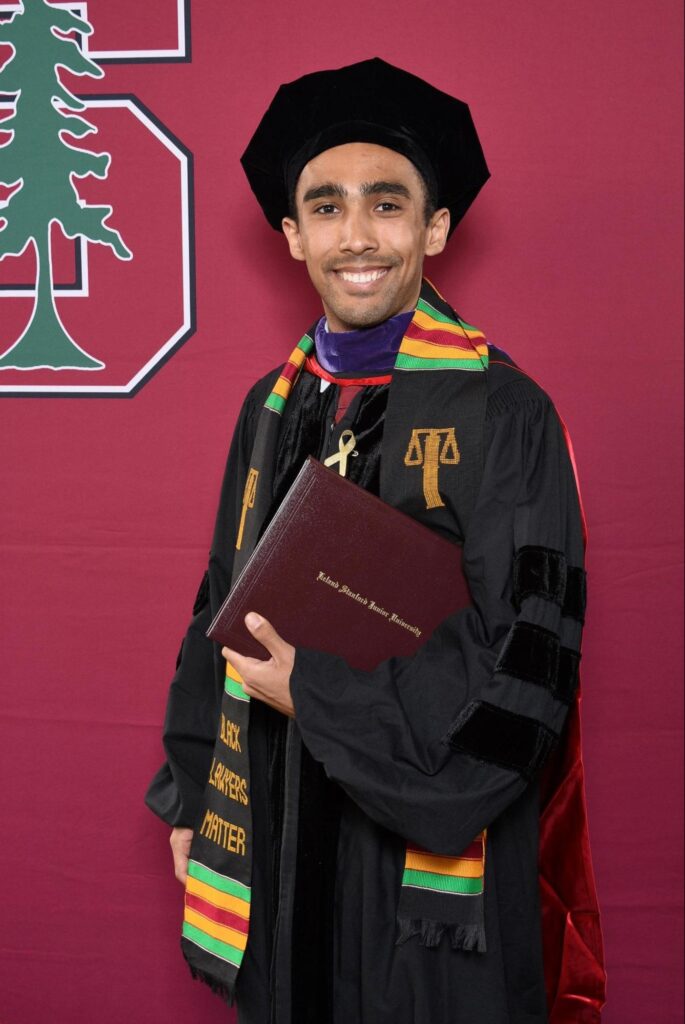
Devon at his Stanford University graduation

A first generation college student, Devon later attended Stanford Law School. He found himself dismayed that even after obtaining a high-quality education, he did not feel he could get ahead financially.

“I don’t think you can ever convince someone that the economy is strong if they can’t buy a house in the neighborhood where they grew up in, even if they make more money than their parents ever did. That’s downward mobility,” he says. “People are feeling that in California and that’s why they are leaving. It’s not the rich people who are leaving, but the middle and low income communities.”

Devon’s drive to combat economic inequality led him to take on roles as a director with Evergreen Strategy Group and as a Special Advisor to Governor Newsom’s Chief of Staff. Eventually, his work and involvement led him to connect with End Poverty in California (EPIC)’s founder Michael Tubbs, who offered Devon an opportunity to lead the organization’s work to connect policy makers to people currently experiencing poverty. 

As the President of EPIC, Devon aligns the organization’s priorities across issue areas to make a lasting impact for Californians. EPIC organizers and staff go around California learning about low-income communities and communities of color in order to uplift their voices and perspectives in the halls of power in Sacramento, where policy decisions for Californians are decided. 

“We are constantly on the ground talking to people living in poverty to ensure the policies we’re advocating for are led by them and informed by their lived experiences. We ask simple questions like: ‘What does the government get wrong about poverty?’ And we take those learnings and incorporate that into our policy advocacy and into our storytelling work,” shares Devon. 

Devon encourages those looking to build economic opportunities to go into their communities, hold listening sessions, and learn from people who have lived experiences. “We can’t be making assumptions that we know what’s best for other people. We have to make sure that the folks we’re actually trying to serve are in the driver’s seat moving forward,” he says. 

EPIC is currently working with legislators in both the California State Assembly and Senate to put together a package of legislation focused on ending poverty in the state that will cover everything from access to benefits, to housing rights, to criminal justice reform and capital for small business owners. 

“Systems have been influenced by false narratives that poverty is a result of individual or moral failure and that people experiencing poverty are fundamentally flawed. EPIC is changing that narrative. It’s not the people. Poverty is driven by policy choices that have set people up to fail,” says Devon.

Devon believes that people have the power to eradicate poverty through systems change. “For all of us who engage in economic justice work, whether we’re in policy or advocacy or philanthropy, it’s crucial that we internalize the belief that ending poverty is not only vital, but that it’s possible. We must disavow the narrative that poverty is a natural phenomenon of capitalism. With all the political capital, wealth, innovation and brilliance we have in California, it’s unacceptable that we haven’t done more to end poverty,” says Devon.

To stay updated on EPIC, follow them on X (formerly Twitter) and Instagram @endpovertyca or visit their website at endpovertyinca.org.

Samuel Molina: Equipping Communities with Financial Literacy 

PrimaryAdmin · October 4, 2023 ·

Samuel pictured at the Tower District in Fresno, CA

“During the COVID-19 pandemic, I saw too many of my community members hosting car washes to raise money after losing someone. I remember feeling it must be tragic to raise money while also grieving a loved one, and I wanted to create more opportunities for folks to have financial security, especially during a crisis.”

Samuel Molina

Financial literacy is the knowledge of how to make smart financial decisions. It equips people to take control of their finances, which creates resilience against unpredictable life events, and opens up pathways to economic freedom. 

For this blog, we had the opportunity to sit down with Samuel Molina, a financial educator who previously led such programs at Binational of Central California. Currently, Samuel is the CEO and founder of The Academy of Financial Education.

Samuel Molina was born and raised in Fresno and has a deep love for his community. “Growing up in Fresno was a beautiful experience because of the diversity of our residents, local businesses and community leaders,” he says. 

Samuel graduated from Central High School, served in the United States Marine Corps for five years, and attended Fresno State University, where he received his bachelor’s degree in Criminology. After earning his degree, he worked for an organization called Mi Familia Vota as a California State Director, supporting civic engagement and advocacy at the local, state and national level. 

“My work with Mi Familia Vota as a California State Director was successful and rewarding in many ways; we registered over 50,000 voters and helped pass legislation at the state level to expand voting rights for previously incarcerated individuals,” says Samuel. 

After his civic engagement and public service work with Mi Familia Vota, Samuel became interested in learning more about personal financial planning and began working as a Financial Advisor with Northwestern Mutual. After Samuel’s transition from Northwestern Mutual, he was inspired to return to the nonprofit space and expand financial literacy in the Central Valley.

“During the COVID-19 pandemic, I saw too many of my community members hosting car washes to raise money after losing someone. I remember feeling it must be tragic to raise money while also grieving a loved one, and I wanted to create more opportunities for folks to have financial security, especially during a crisis,” he says.

 Samuel contacted Binational of Central California and received the green light to start the organization’s Financial Empowerment Program. Since the Financial Empowerment Program launched in November 2022, it has served over 200 people in Fresno and Madera counties and has hosted over 30 financial literacy sessions. 

“It is such a unique program because it not only teaches traditional banking, credit, loan and debt solution information but also important financial tools like life insurance, investing, education, retirement, and estate planning,” Samuel says.

As part of the program, participants work with staff to reach specific financial milestones, such as creating a budget or signing up for a service to monitor their credit. Many participants make less than $35,000, receive social security payments, or have been taught to fear credit. However, they are motivated and excited to achieve financial stability  for themselves and their families. After completing the program, the participants walk away with tools to build their financial futures.

Samuel is currently the CEO and founder of The Academy of Financial Education, an organization committed to narrowing the wealth gap through activities, coaching, education and instruction. The organization’s programs cover both personal and business financial planning and educates youth and adults. 

In the future, Samuel hopes California can pass legislation that enables schools to offer financial literacy in K-12 classrooms. He also wants to see more banks expand their services to communities of color, especially rural communities throughout the Central Valley, in place of predatory cash-checking companies.

“My overall vision is for families to have the resources to withstand a financial setback like a pandemic or an unexpected emergency so that they are no longer as disproportionately impacted. Generational wealth is achieved through financial literacy. I want to equip our communities with the financial tools, resources, and information so they can make smart decisions that will support their economic well-being,” he says.

To learn more and find helpful financial literacy resources, Samuel recommends: 

  • www.taofe.org 
  • www.bankrate.com 
  • www.consumerfinance.gov 

Derek Steele: Uplifting Communities as Change Agents

PrimaryAdmin · October 4, 2023 ·

Photo of Derek taken outside of the Social Justice Learning Institute building

“Nonprofit organizations need to ensure people have economic freedom so that they have the capacity to get more involved with their school systems, local politics or even work environments. That’s how we’re truly able to create liberated spaces.”

Derek Steele

For this blog, we had the opportunity to sit down with Derek Steele, executive director of Social Justice Learning Institute (SJLI), an organization that empowers youth and their communities to drive change. Learn more about Derek and SJLI’s work to improve the well-being of youth and communities of color through research, training and community mobilization below.

Derek Steele was born and raised in Pittsburgh, Pennsylvania. “As a preacher’s kid, I grew up focused on service. My pops was always on me about being super conscious of the world, liberating all folks, and centering Black folks and their lived experiences in the fight for equity. He even had me reading the ‘Autobiography of Malcolm X’ at age 10,” shares Derek.

It was in Baltimore, Maryland while attending the historically Black college Morgan State University, however, that Derek gained an even greater sense of self within Black culture. Through campus life and mandatory courses like “African Diaspora,” he found inspiration in seeing people who looked like him come together and be intentional about learning. 

After graduating from Morgan State with a bachelor’s degree in electrical engineering, Derek moved to Inglewood, California for a career opportunity as an engineer with Northrop Grumman, where he learned about using a systems approach to wield outcomes. Using the tools and skills he acquired at Northrop Grumman, Derek began serving as a volunteer 14 years ago at the Social Justice Learning Institute and stayed after seeing the impact SJLI was making in educating and organizing communities of color. 

Today, he is now an executive director with a team of 53 members. In his role, Derek leads SJLI’s work to improve health, education and well-being for people of color. 

“A lot of our focus is on participatory research, with the aim of equipping youth and communities with the tools to perform qualitative and quantitative data so they can then use it to lead social movements. The participatory research helps them understand what is going on around them so they can identify and rectify injustice and advocate for policies that address their needs, all through the context of both lived experience and evidence-based research,” says Derek. 

Participatory research, however, is just one of many of SJLI’s focuses. Through their various programs, SJLI youth participants have helped start the police-free schools movement in Inglewood and build the city’s first community garden. 

SJLI Youth Justice Fellows in Puerto RIco

SJLI’s flagship program, Urban Scholars, serves middle and high school students representing 22 schools in both Houston and Los Angeles. The program supports them through four key areas: academic and career development, socio-emotional support, self-esteem development and youth leadership. To date, the program has served over 3,000 students. 95% of students in the program graduate from high school and 80% go to college.

“We don’t just support the ‘talented tenth’ through this program. We reach students who might have barriers to completing their education and need more wraparound support. We help transform them into leaders for them to go on to create positive change in their schools,” says Derek.

Derek believes that education bridges the economic gap by equipping  those most impacted by inequitable systems to create people-centered solutions that help individuals live full, free, thriving and healthy lives. 

“It was the people and community organizers who helped to get Measure J passed in Los Angeles, which requires at least 10% of locally generated unrestricted revenue be invested into communities and alternatives to incarceration,” he says. 

SJLI’s work to educate communities encourages people of color to drive change and live a life of abundance, not scarcity. Understanding the barriers and challenges facing Inglewood residents, SJLI is supporting their economic stability through the building of its new headquarters, which will now include 120 units of affordable housing, in collaboration with Venice Community Housing. The development is scheduled to be completed in 2026. 

“Nonprofit organizations need to ensure people have economic freedom so that they have the capacity to get more involved with their school systems, local politics or even work environment. That’s how we’re truly able to create liberated spaces,” says Derek.

Derek hopes that by supporting boys and men of color and focusing on their lived experiences, SJLI can help communities rethink public safety and create shared abundance. 

“The systems that are created through centering Blackness can then be extrapolated and scaled to help all communities,” he says. Recognizing that thriving communities can’t be achieved without women and girls, the organization is also piloting an Urban Scholars for Young Women program this fall to help support the next generation of women leaders.

Derek advises philanthropic and government organizations to focus more on people-centered economies. “Philanthropy – do the work to put yourselves out of business. Be thoughtful about how you can use funds to be transformative. Government – get out of the way. Steward the resources to help people and give them what they are saying they need. Both entities need to let nonprofit, faith-based, and community-based organizations be the foundation of change,” he says. 

To stay updated on SJLI, follow them on X (formerly Twitter) and Instagram at @SJLI_CA or visit their website at sjli.org. To get involved in one of their programs, visit sjli.org/get-involved. 

Copyright © 2026 #HeretoLeadCA. All Rights Reserved